
Continuous chemical equipment
provider
provider


As the global demand for nickel—especially for electric vehicle batteries and stainless steel production—continues to surge, laterite nickel ore has become the primary source of primary nickel due to the depletion of high-grade nickel sulfide ores. However, extracting nickel from laterite nickel ore faces significant challenges: low nickel grade (typically 0.8%–1.5%), high impurity content (such as magnesium and iron), high energy consumption and reagent waste in traditional processes, and low nickel recovery rates that fail to meet industrial and battery-grade standards. To address these pain points, the mixer-settler has emerged as a core equipment in hydrometallurgical nickel extraction, offering stable operation, high separation efficiency, and cost-effectiveness. This article details how mixer-settlers optimize nickel extraction from laterite nickel ore, their working principles, practical applications, optimization strategies, and why they are the key to bridging the gap between raw ore resources and high-value nickel products.
Laterite nickel ore accounts for over 70% of global nickel reserves, making it an irreplaceable resource for meeting long-term nickel demand. Unlike nickel sulfide ores, laterite nickel ore is a low-grade oxide ore that requires hydrometallurgical processes (such as leaching and solvent extraction) to extract nickel—a process where the efficiency of liquid-liquid separation directly determines the overall recovery rate and economic benefits. Traditional extraction equipment, such as centrifugal extractors or extraction towers, often struggle with the high viscosity and solid particle content of laterite leachate, leading to emulsification, reagent loss, and unstable operation. These issues result in nickel recovery rates as low as 75%–80%, high operational costs, and difficulty in producing battery-grade nickel (purity ≥99.9%).
Mixer-settlers address these challenges by leveraging gravity-based phase separation and efficient mass transfer, making them ideal for large-scale laterite nickel extraction. Their simple structure, low maintenance requirements, and ability to handle high-viscosity feed solutions fill the technical gap left by traditional equipment, enabling mines to achieve higher recovery rates, lower costs, and meet the growing demand for high-purity nickel in new energy and manufacturing industries.
The core function of a mixer-settler in nickel extraction is to separate nickel ions from impurities (magnesium, iron, calcium, etc.) through solvent extraction, relying on the principle of interphase mass transfer between aqueous and organic phases. The entire process consists of three key stages, each tailored to the characteristics of laterite nickel ore leachate:
The nickel-bearing leachate (aqueous phase) and extractant (organic phase) are fed into the mixing chamber of the mixer-settler. A stirring system—typically a turbine or paddle agitator—disperses the organic phase into tiny droplets, maximizing the contact area between the two phases. This dispersion allows nickel ions in the aqueous phase to react with the extractant, forming stable complexes that migrate from the aqueous phase to the organic phase. For laterite leachate, which often has high viscosity, adjusting the stirring power density to 0.8–1.5 kW/m³ ensures sufficient dispersion without causing emulsification, a common issue that leads to nickel loss and extractant failure.
The extractant is specifically selected to have a higher affinity for nickel ions than for impurity ions. For example, organic extractants such as P204 and P507 are widely used in laterite nickel extraction, as they can selectively bind to nickel ions while leaving magnesium, iron, and other impurities in the aqueous phase. This selective separation reduces the need for additional purification steps, simplifying the process and lowering reagent consumption. In practical applications, a three-outlet mixer-settler system can separate nickel-rich organic phase, nickel-cobalt organic phase, and impurity-rich aqueous phase in a single extraction step, further improving efficiency.
After mixing and mass transfer, the two-phase mixture flows into the settling chamber through an overflow baffle. Due to the density difference between the aqueous phase (heavier) and organic phase (lighter), the mixture naturally stratifies: the nickel-loaded organic phase floats to the top, while the impurity-rich aqueous phase settles at the bottom. Separate outlets for each phase ensure efficient collection— the nickel-loaded organic phase is sent to the stripping stage to recover nickel, while the aqueous phase is treated for impurity removal and reuse. The settling chamber accounts for 60%–80% of the mixer-settler’s total volume, with guide baffles added to avoid turbulence from the mixing chamber affecting phase separation.
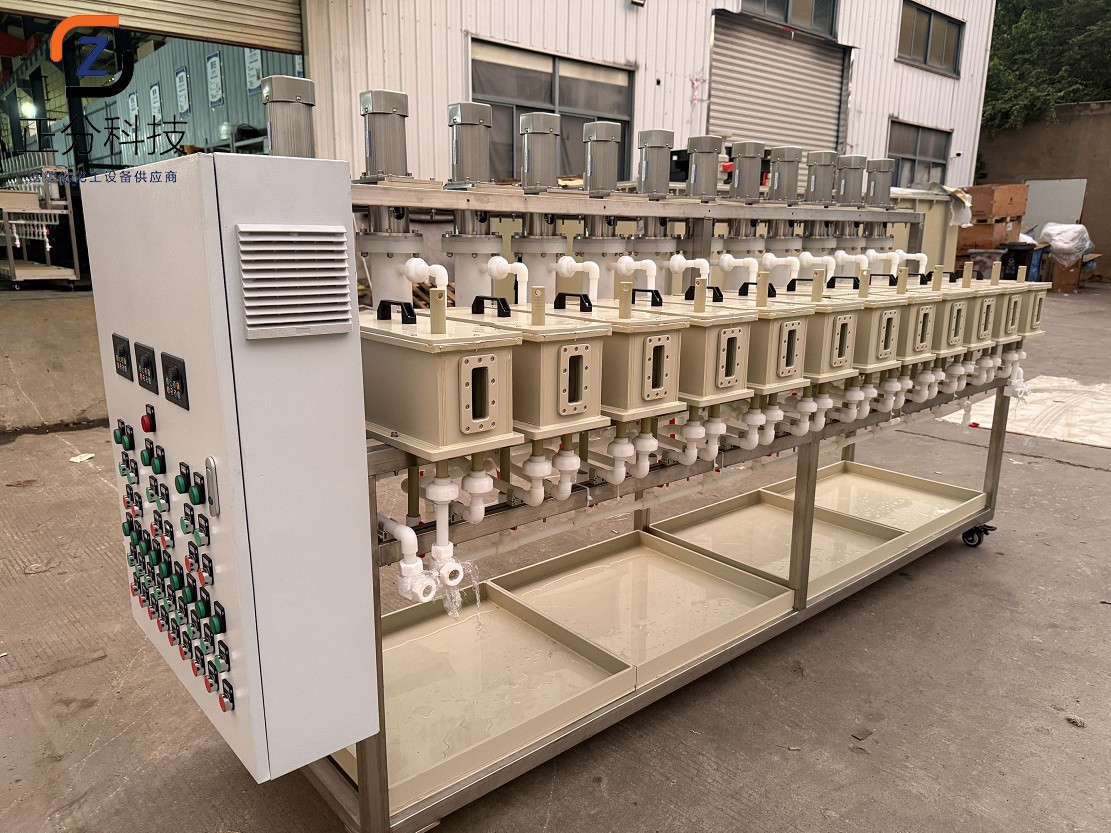
Mixer-settlers have been widely adopted in large-scale laterite nickel extraction projects worldwide, with proven performance in improving recovery rates and reducing costs. A typical application case from a Jinchuan nickel-cobalt concentrator demonstrates their effectiveness: after introducing optimized mixer-settlers to handle high-viscosity, low-nickel, high-magnesium laterite leachate, the nickel recovery rate increased from 78% to over 92%, while the nickel content in wastewater dropped from 0.15 g/L to 0.008 g/L. Additionally, extractant consumption decreased by 40%, saving over 5 million yuan annually in reagent and environmental treatment costs.
Compared to other extraction equipment, mixer-settlers offer three key advantages for laterite nickel extraction:
First, they are highly adaptable to complex feed solutions. Unlike centrifugal extractors, which require low-viscosity, solid-free feed, mixer-settlers can handle laterite leachate with small solid particles and high viscosity, reducing the need for pre-treatment steps. Second, they operate stably with low maintenance costs. Without high-speed rotating components, mixer-settlers have low failure rates and can run continuously for over 8,000 hours with proper maintenance. Third, they support large-scale production. By designing multi-stage series systems (typically 3–10 stages for extraction, washing, and stripping), mixer-settlers can achieve deep nickel separation and purification, meeting the standards for battery-grade nickel (purity ≥99.9%) required for electric vehicle batteries.
To maximize the performance of mixer-settlers in laterite nickel extraction, targeted optimization of structure and process parameters is essential. These optimizations focus on improving mass transfer efficiency, stabilizing phase separation, and reducing operational costs:
The mixing chamber and settling chamber are the core components requiring optimization. For the mixing chamber, selecting the right agitator type (turbine or paddle) and adjustable speed motors allows operators to adjust stirring intensity based on feed viscosity—avoiding insufficient mixing (which reduces mass transfer) or excessive mixing (which causes emulsification). For the settling chamber, increasing the volume ratio and adding anti-turbulence baffles improves phase separation stability. Additionally, using corrosion-resistant materials (such as PTFE lining or titanium alloy for acid leachate, and 316L stainless steel for weak-corrosion feed) extends equipment lifespan and reduces maintenance costs.
Key process parameters include the organic-aqueous phase ratio, residence time, extractant concentration, and saponification degree. For laterite nickel leachate, the organic-aqueous phase ratio is typically controlled between 1:1 and 5:1 to ensure sufficient mass transfer. The residence time in the settling chamber is set to 1.2–2 times the theoretical equilibrium time to ensure complete phase separation. The extractant concentration (e.g., 5%–30% for P204) and saponification degree (40%–60%) are adjusted to enhance selective nickel extraction, reducing impurity interference.
Integrating automatic monitoring systems (for pH, flow rate, and phase interface) allows real-time adjustment of process parameters, reducing human error and improving stability. For example, real-time pH monitoring ensures the extractant’s selectivity, while phase interface control prevents phase entrainment and nickel loss. Intelligent control also reduces operator demand by 70%, further lowering operational costs.
With the growing emphasis on carbon neutrality and green mining, mixer-settlers are evolving to meet stricter environmental and efficiency requirements. Future developments will focus on two key areas: circular economy integration and process intensification. By recycling extractants and treating wastewater, mixer-settler systems can reduce reagent waste and environmental impact—for example, extractant recycling rates can reach over 95% with optimized stripping processes. Additionally, combining mixer-settlers with advanced leaching technologies (such as HPAL) will further improve nickel recovery rates and reduce energy consumption, aligning with the trend of low-carbon nickel production.
As the demand for battery-grade nickel continues to grow, mixer-settlers will remain a critical technology for laterite nickel extraction. Their ability to solve industry pain points—low recovery rates, high costs, and unstable operation—makes them an indispensable part of the global nickel supply chain, supporting the development of new energy and manufacturing industries.
Focus on being Continuous chemical equipment
provider.
If you want to learn more about our centrifugal extractor, mixer settler, Contact us Now